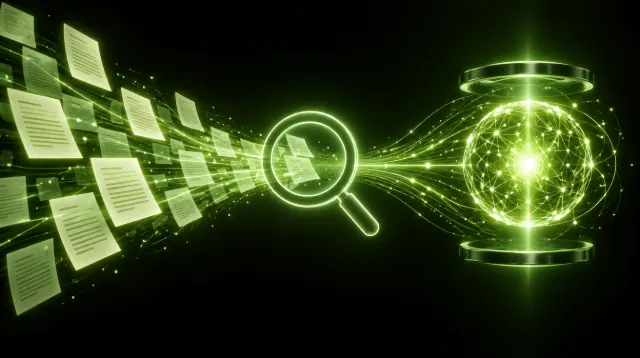
RAG Explained: How AI Chats With Your Own Documents
Retrieval-augmented generation (RAG) explained: how AI answers from your documents, embeddings and vector search, chunking, and why RAG reduces errors.

What AI agents are, how they plan and use tools, what they can reliably do today, where they fail, and how to use them safely with the right guardrails.

“Agents” are the most hyped idea in AI right now. Strip away the marketing and the concept is simple and genuinely useful, with limits worth understanding.
A chatbot answers a message. An agent works towards a goal over several steps:
Many successful “agent” systems are really workflows: fixed sequences of AI steps with clear handoffs. They’re more predictable. Use open-ended agents only where flexibility is truly needed.
Begin with a narrow, repetitive task you understand well. Define what “done” looks like, add a human checkpoint and measure the time saved. Clear instructions matter even more for agents; our prompt engineering guide covers the basics, and RAG explained shows how agents can use your own documents.
No. Chatbots respond to messages; agents take multiple steps and use tools to complete tasks.
They can automate specific tasks, but most work still needs human judgement, context and accountability.
They can be, with limited permissions, human approval for important actions and careful monitoring.

Every article is edited by a human and checked against our editorial policy. Spotted a mistake? Tell us.
Retrieval-augmented generation (RAG) explained: how AI answers from your documents, embeddings and vector search, chunking, and why RAG reduces errors.
How large language models work, in plain English: tokens, training, transformers and attention, fine-tuning, context windows and why they make mistakes.
Why AI chatbots hallucinate, making up facts, quotes and sources with confidence, which tasks are riskiest, and how to reduce errors and check answers.